

Best Koa Wood Ring for Daily Wear

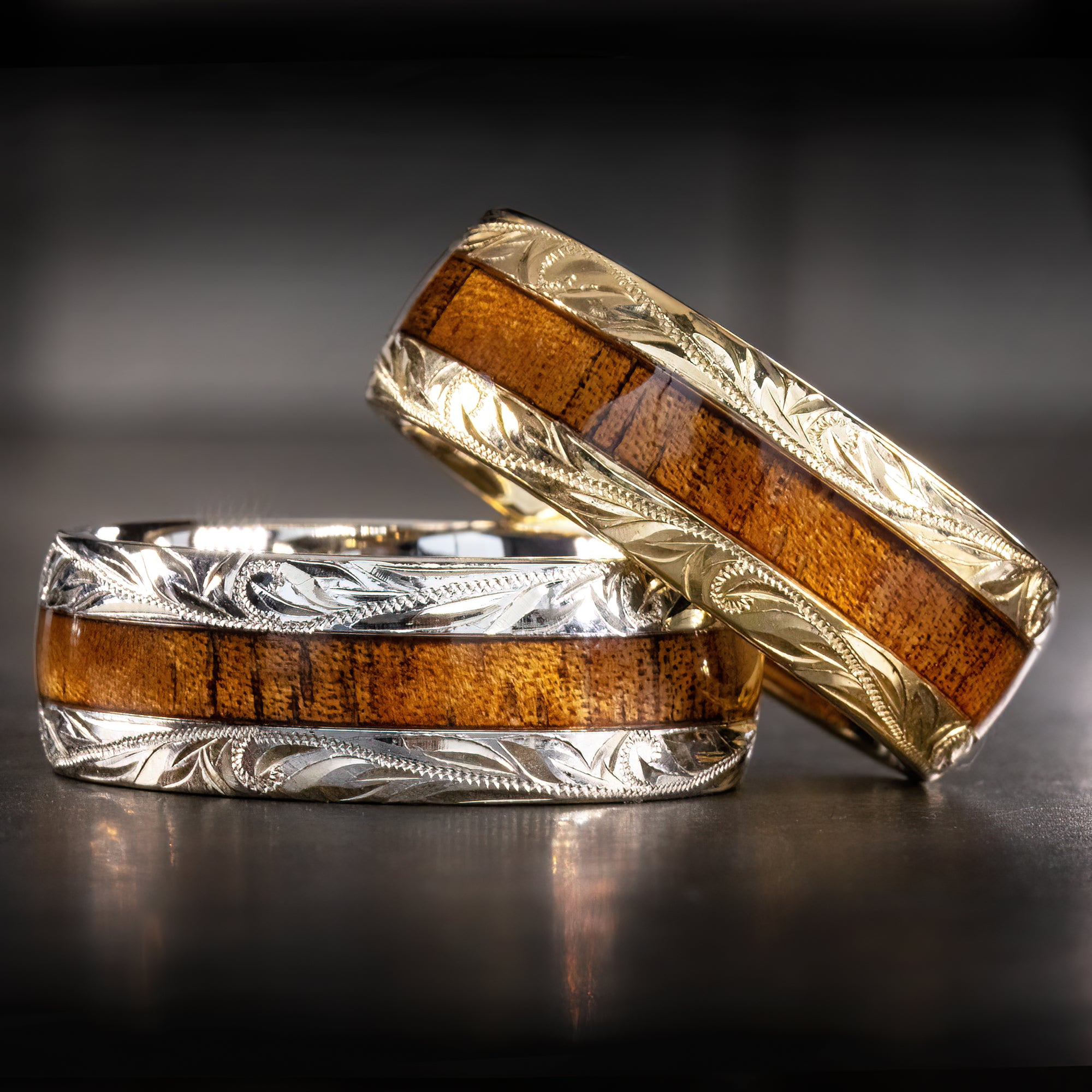
Every koa wood ring we at Happy Laulea make pairs the same island hardwood with a very different metal, and that metal decides almost everything about how the ring ages on your hand. A tungsten carbide band shrugs off keys and countertops. A solid gold band picks up a patina of fine scratches but can be polished and passed down. A gold-plated band gives you the warm gold look at a fraction of the price, with the understanding that the color lives on the surface.
This guide compares the options of which one is right for you.
Quick summary
| Your situation | Best match | Why |
|---|---|---|
| Heavy-duty daily wear (trades, ranch work, lifting, tools) | Titanium with koa inlay | Won't shatter under impact. Scratches, but bends and dents rather than cracking. Lightest option on a working hand. |
| Everyday moderate use (office, parenting, dishes, travel) | Tungsten carbide with koa inlay | The most scratch-resistant metal we stock. Holds its polish for years with almost no maintenance. |
| You want the gold look without the gold price | Gold-plated or ion-plated tungsten with koa inlay | Gold tone over a near-unscratchable core. Expect the color layer to soften over time. |
| Heirloom, ceremony, or once-in-a-lifetime piece | Solid 14K or 18K gold with koa inlay | Gold all the way through. Refinishable, repairable, and it holds real material value. |
| Sensitive skin or nickel allergy | Titanium | 100% hypoallergenic. Tungsten is cobalt-free and fine for most people, but titanium is the safer default. |
| Budget, backup, or beach-trip ring | Stainless steel with koa inlay | Tough, inexpensive, and no heartbreak if it gets dinged or lost. |
| Genuinely wet hands all day (surf instructor, nurse, swimmer) | A plain metal band for work, koa ring for the rest of the time | No wood inlay ring, at any price, is built for constant soaking. More on that in section 4. |
Top picks from our collection
Best for heavy-duty daily wear
 Titanium Ring with Hawaiian Koa Wood Inlay, 8mm flat. Light on the hand, hypoallergenic, and it will not shatter if you catch it on something.
Best for everyday moderate use
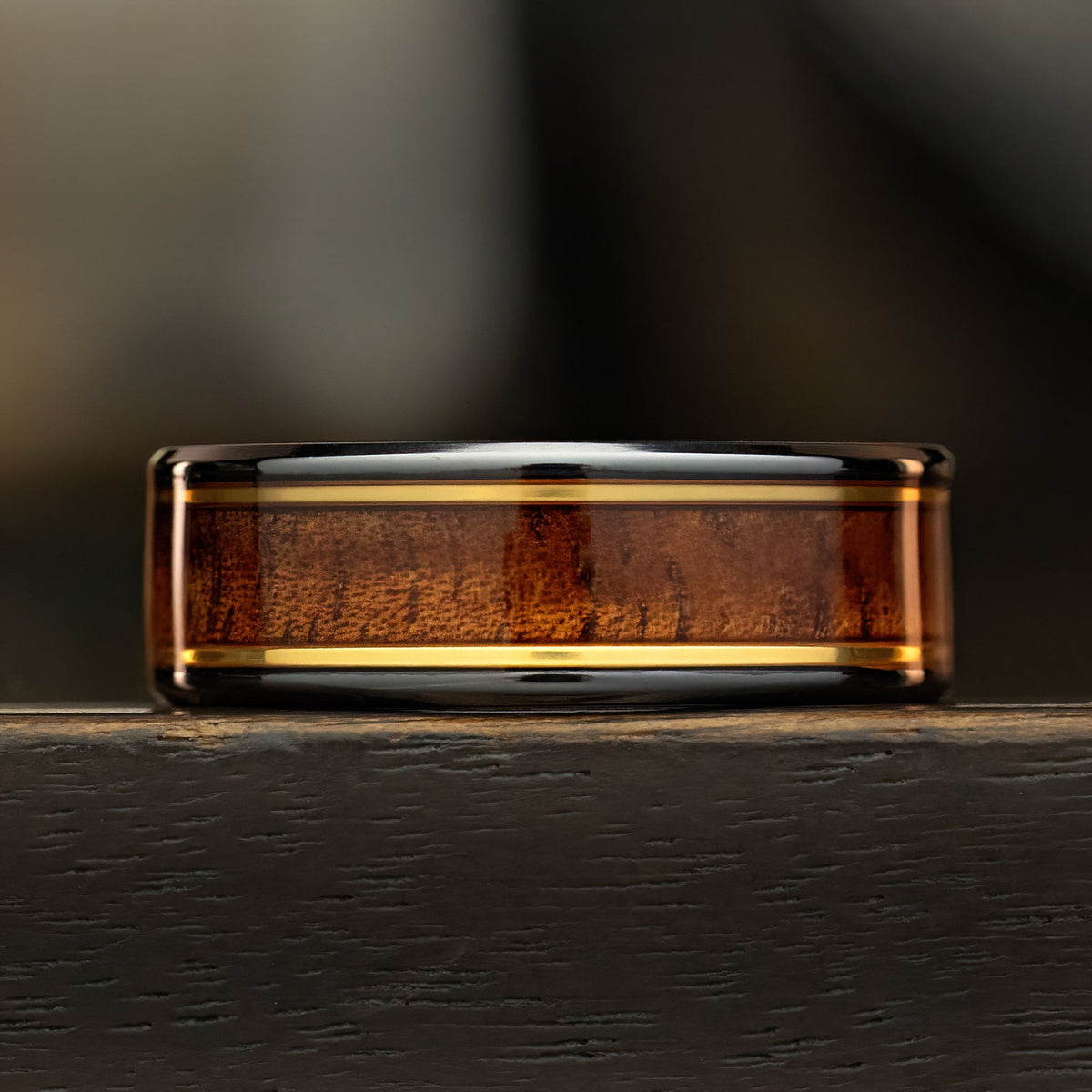
 Tungsten Carbide Gold Plated Ring with Koa Wood Inlay, 6mm dome. The domed profile deflects contact, the tungsten core stays polished, and the koa reads warm against the gold tone.
Best heirloom piece
 Solid Gold Ring with Hawai'i Koa Wood Inlay, 3mm flat. 14K or 18K in yellow, rose, or white. Made to order, roughly 8 weeks.
Best matching set
 Pair of Tungsten Carbide Gold Plated Rings with Koa Wood Inlay, 6 & 8mm.
Best petite / stacking option
 Petite Tungsten Carbide Yellow Gold ION Plated Ring with Koa Wood Inlay, 3mm. Ion plated, so the color layer holds up better than standard plating.
Best two-tone statement
 Tungsten Carbide Black & Gold Ion Plated Ring, 8mm, Koa Wood Inlay.
Best budget pick
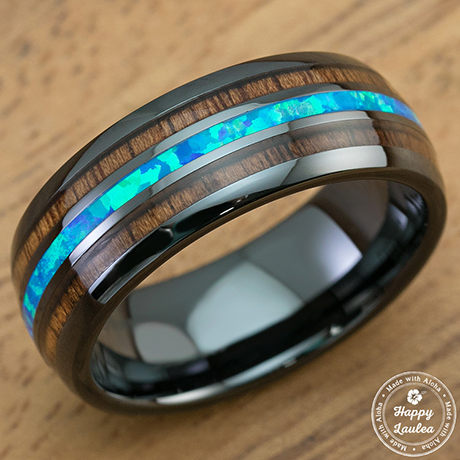
 Stainless Steel Ring with Koa Wood and Mid-Strip Turquoise Inlay, 8mm.
Browse more: Hawaiian Koa Wood collection · Gold Plated · Gold Wedding Rings · Titanium
Materials compared: solid gold vs gold-plated tungsten vs titanium
Solid 14K / 18K gold
Gold is the softest option here and the only one that is genuinely permanent in color. The gold is the metal, not a coating, so it cannot wear off. It will pick up hairline scratches and, on wider bands, occasional dents, but a bench jeweler can polish those out indefinitely.
18K is richer in color and slightly softer than 14K. 14K is the more practical daily-wear choice for most people.
Pros: permanent color, refinishable, repairable, real resale and sentimental value, resizable in limited increments.
Cons: highest price, softest surface, longest lead time. Our solid gold koa pieces are made to order and take roughly 8 weeks.
Shop it: Solid Gold Ring with Hawai'i Koa Wood Inlay, 3mm flat (14K or 18K, yellow / rose / white) · 14K White Gold Ring with Offset Koa Wood Inlay, 8mm · Browse all Gold Wedding Rings
Gold-plated and ion-plated tungsten carbide
Tungsten carbide is the hardest material in our catalog. Our gold-toned versions take that band and add a gold-colored surface layer, either standard gold plating or ion plating (IP), a vacuum process that bonds the color layer more tightly than traditional electroplating.
The core never scratches meaningfully. The color layer is the variable. Ion plating outlasts standard plating, and both last longer on a low-contact area of the ring than on the high points that rub against desks, steering wheels, and pockets.
Pros: exceptional scratch resistance, gold aesthetic at a modest price, comfort fit, cobalt-free and hypoallergenic to most people. Cons: the gold tone is a surface layer with a finite life. Tungsten cannot be resized. Tungsten is hard but brittle, so a sharp strike on concrete can crack it.
Shop it: Tungsten Carbide Gold Plated Ring with Koa Wood Inlay, 6mm dome · Same design in 8mm · Matching 6 & 8mm pair · Browse the full Gold Plated collection
Titanium
Titanium's real advantage is its strength-to-weight ratio, not raw strength. Plenty of steels beat titanium on absolute tensile and yield strength; what titanium does is deliver comparable strength at roughly 45% less weight, along with excellent corrosion resistance and biocompatibility. It is also hypoallergenic, which is why it's used for surgical implants.
It is not as scratch-resistant as tungsten, and it will show surface wear over a few years of hard use. What it does instead is deform rather than fracture, which is a real advantage if your hands take impact.
Pros: lightest to wear, safest under impact, fully hypoallergenic, mid-range price. Cons: scratches more visibly than tungsten, and like tungsten it isn't resizable once a koa channel is set.
Shop it: Titanium Ring with Hawaiian Koa Wood Inlay, 8mm flat · Titanium Ring with Koa Wood Inlay, hand engraved Hawaiian heritage design, 6mm · Browse the Titanium collection
Stainless steel
The value option. We use 316L, the marine-grade alloy also used for surgical instruments, which resists corrosion well. It's heavier than titanium, softer than tungsten, and extremely difficult to damage in a way that matters. Rose-gold-toned stainless pieces carry the same plating caveat as the tungsten ones, though plating tends to adhere and last better over stainless than over softer base metals like brass.
Shop it: Stainless Steel Ring with Koa Wood and Mid-Strip Turquoise Inlay, 8mm · Stainless Steel Ring with Koa and Black Wood Inlay, 6mm
Durability metrics and what they actually mean for daily wear
Mohs hardness is the standard scratch-resistance scale, running from talc at 1 to diamond at 10. Each step is significantly harder than the last, not evenly spaced.
| Material | Mohs hardness | Scratch resistance | Behavior under sharp impact | Finish longevity | Resizable |
|---|---|---|---|---|---|
| Tungsten carbide | ~8.5 to 9 | Excellent | Brittle. Can crack or chip | Polish lasts years | No |
| Ceramic (HI-TECH) | ~8 | Excellent | Brittle. Can chip | Very stable | No |
| Stainless steel (316L) | ~5 to 6 | Good | Bends, won't crack | Scuffs, buffable | No |
| Titanium | ~6 | Moderate to good | Bends or dents, won't crack | Develops a soft patina | No |
| 14K gold | ~3.5 to 4 | Low | Dents and deforms | Refinishable forever | Limited, by half sizes |
| 18K gold | ~2.75 to 3 | Low | Dents and deforms | Refinishable forever | Limited, by half sizes |
| Hawaiian koa wood | ~1,170 lbf Janka | Low, protected by finish | Can dent or chip | Depends on sealant | Not applicable |
What to take from this table:
- Scratch resistance is not the same as toughness. Tungsten and ceramic win on scratches and lose on impact. Titanium and steel are the opposite. Gold loses on both but is the only one that can be restored to new by a jeweler.
- Hardness is not the same as finish longevity. A gold-plated tungsten band has a near-unscratchable core and a color layer measured in fractions of a micron. Those two facts live in the same ring.
- Width and profile matter more than people expect. An 8mm flat band presents more surface to the world than a 6mm dome. Domed and comfort-fit profiles deflect contact instead of catching it.
- Nothing here is resizable once a koa channel is set, apart from small adjustments on precious metal. Get sized properly before you order. See our ring size chart.
Hawaiian koa wood inlay: sealing, water exposure, and care
Koa is a Hawaiian hardwood with a Janka hardness of about 1,170 lbf, which puts it between cherry and white oak. That's respectable for a wood and irrelevant compared to any metal. In our rings it sits in a machined channel and is protected by a sealant. That sealant is what stands between the wood and the world.
Is the koa sealed?
Yes. Our koa inlays are finished with a protective coating that resists moisture and everyday handling. What that coating is not is a permanent waterproof barrier. It slows moisture ingress; it does not stop it forever, and it degrades with chemical exposure.
You may see stronger language elsewhere on this site. Several product pages describe these rings as "waterproof," and at least one states that the protective coat allows the ring to be submerged in water. Those descriptions are more optimistic than our own Ring Care Guide, which notes that wooden rings are not always water-resistant and that swimming isn't ideal.
Where they disagree, follow the conservative version in this guide. The metal band genuinely is waterproof. The wood inside it is sealed, which is a different and more limited promise, and treating it as fully waterproof is the fastest way to shorten the life of the inlay.
Water, salt, and chlorine
- Handwashing and rain: fine. Dry the ring afterward with a soft cloth.
- Showering: avoid it. Hot water, steam, and soap residue are the most common cause of slow seal failure, simply because it happens daily.
- Ocean: a sealed ring tolerates brief splash contact. Rinse it in fresh water promptly afterward and pat it dry. Do not swim, surf, or soak in it.
- Pools and hot tubs: take the ring off. Chlorine actively degrades protective coatings faster than saltwater does.
- Humidity: koa is fine in a normal humid climate, including Hawaii. What it doesn't like is being stored damp. Let it air dry fully before it goes in a box.
Cleaning and maintenance
- Mild soap and water on a soft cloth is the whole routine. Wipe, don't soak.
- Skip solvents, bleach, acetone, alcohol wipes, and jewelry dips. They eat sealant.
- Never put a wood inlay ring in an ultrasonic or steam cleaner.
- Apply a small amount of wood conditioner or a food-safe oil (beeswax or mineral oil) once or twice a year to keep the grain from drying out. Buff off the excess.
- Take the ring off for yard work, gym sessions, gardening, and anything involving solvents or heavy grip.
Warning signs your seal is failing
Dullness that won't buff out, a cloudy or white film, raised or fuzzy-feeling grain, hairline cracks, or any lifting at the seam where wood meets metal. Catch these early and contact us rather than reaching for a hardware store sealant, which will usually make the repair harder.
For a deeper treatment of this topic, see Koa Wood Rings and Ocean Exposure.
Plating longevity and re-plating options
Standard gold plating applies a thin gold layer to a base metal. For context on how thin: the US Federal Trade Commission allows a piece to be called "gold plated" or "gold electroplate" at a minimum of about 0.175 microns of at least 10K gold, and reserves "heavy gold electroplate" for 2.5 microns and up. Most plated jewelry falls somewhere between 0.5 and 2.5 microns. A human hair is around 70 microns for comparison.
On a ring, which sees more friction than any other piece of jewelry, that layer commonly shows visible wear somewhere between a few months and a couple of years of daily wear, depending on thickness and habits. It goes first on the high points and the palm side.
Ion plating (IP) is a form of physical vapor deposition, a vacuum process that bonds the color layer far more tightly than electroplating. PVD gold coatings typically run 0.5 to 2.5 microns and are substantially more wear-resistant than conventional plating at the same thickness. Our rose gold IP, yellow gold IP, and black IP tungsten pieces use it. It meaningfully outlasts standard plating, but it is still a surface layer and still finite.
One thing to know before you engrave a plated ring: engraving cuts through the plating. Our own warranty terms note that engraving on plated rings may weaken the plating and cause chipping, and that this isn't covered. If you want a personalized engraving on a gold-toned ring you'll wear daily, solid gold is the safer substrate.
Solid gold has no plating to lose.
What extends plating life
- Take the ring off for the gym, cleaning, gardening, and swimming.
- Put it on after lotion, sunscreen, perfume, and cosmetics, not before.
- Rinse and dry after sweat or saltwater.
- Wipe with a soft dry cloth. No polishing compounds, no abrasive cloths, no dips.
- Store it separately so harder pieces don't abrade it.
Can it be re-plated?
Jewelry re-plating is a common service, and simple items are often refinished for modest cost. Tungsten carbide with a wood inlay is a harder case: the plating bath and the prep involved are not friendly to a sealed wood channel, and most jewelers will decline. In practice, replacement is the realistic path when plating wears through on a gold-toned tungsten ring, which is a strong argument for buying the plated version as a fashion-forward everyday ring rather than as a fifty-year band.
If gold color that never fades is the requirement, buy solid gold. If gold color is the requirement, buy plated and go in with clear expectations.
FAQ
How long will the gold plating last on a tungsten ring? Standard gold plating on a daily-wear ring typically shows visible wear within months to about two years. Ion plating lasts noticeably longer. Removing the ring for the gym, cleaning, and swimming is the single biggest factor in stretching that timeline.
Is a koa wood inlay ring waterproof? The metal is. The wood is sealed, not waterproof. Handwashing and incidental splashes are fine if you dry it. Showering, swimming, chlorinated pools, and soaking are not.
Can my ring be resized? Tungsten carbide, titanium, ceramic, and zirconium cannot be resized. The heat and mechanical stress involved would break the bond holding the koa channel and risk cracking the wood. Solid gold, sterling silver, and platinum Hawaiian heirloom pieces can be adjusted by half sizes, with fees possible beyond that. For non-resizable materials, a size exchange is the solution.
What if I ordered the wrong size? Non-engraved HI-TECH ceramic, tungsten carbide, titanium, and zirconium rings can be exchanged within 100 days of receipt. You print a return label for $7 to send the ring in, and we cover shipping the exchanged ring back to you within the US. Rings engraved with a personalized message are not exchangeable. Full details are on our Exchange & Return Policy page.
What about returns for a refund rather than an exchange? Refunds run on a shorter clock than exchanges: 15 days from receipt, with the refund issued within about 10 days of us receiving the item. Engraved and custom-ordered items can't be returned, and solid 14K gold, 18K gold, and platinum rings carry a 15% restocking fee on returns.
What does the warranty cover? We offer a 2-year "No Hassle" limited warranty covering manufacturing defects from the original order date, with a one-time replacement at no cost given proof of purchase and a clear photo of the defect. If the exact style is unavailable, we may substitute a similar ring of equal value.
Not covered: normal wear and tear, lost or stolen items, changes in ring size, damage from harsh chemicals or misuse, and rings bought through third-party resellers. The terms also state specifically that gold and colored plating may wear over time and that engraving on plated rings may weaken the plating and cause chipping. Neither is a warranty claim. Discontinued styles may no longer be serviceable. See the Warranty page for current terms.
Will the koa wood in my ring look exactly like the photo? No, koa varies by region of the Big Island and by position within a single trunk, ranging from pale gold through orange and deep red to nearly black. Each ring is unique.
My inlay looks dull. Is it ruined? Probably not. Dullness is often just the sealant asking for attention. Clean gently, dry fully, and apply a light wood conditioner. If you see cracking, lifting at the seam, or a persistent white film, reach out to us before trying to repair it yourself.