
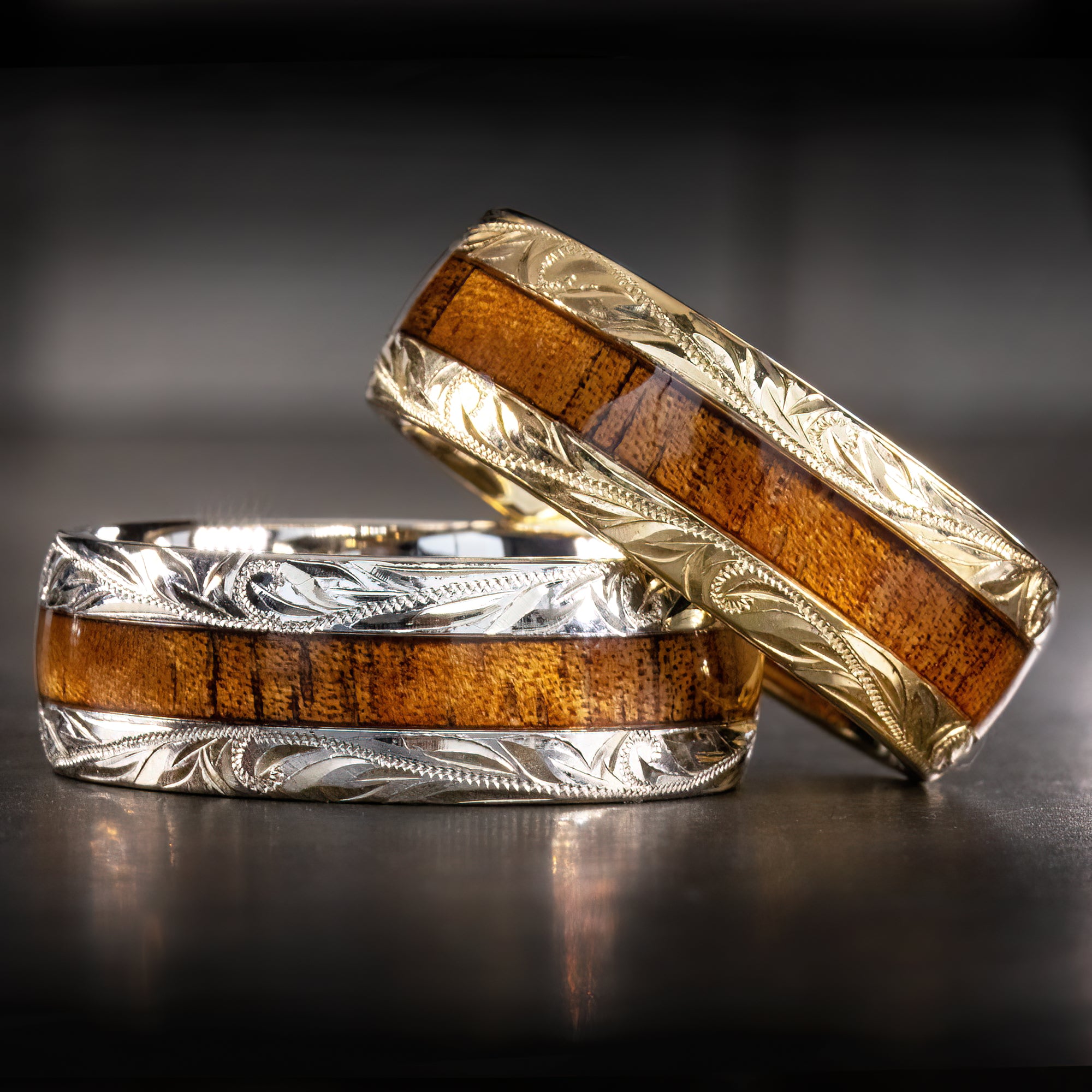

Best Gold Koa Wood Ring for Daily Wear
Choosing a gold koa wood ring for daily wear is mostly a materials question. The gold color is only the surface story. What sits underneath (solid gold, a plated tungsten core, or titanium) decides how the ring handles scratches, bumps, water, and the years ahead. As Happy Laulea puts it in its guide "Best Koa Wood Ring for Daily Wear," every koa ring pairs the same island hardwood with a very different metal, and "that metal decides almost everything about how the ring ages on your hand."
This article walks you through the three real options, the care the koa inlay needs, and the sizing rules that catch many buyers off guard.

Quick answer: match your gold koa ring to your daily routine
-
Hard use (tools, countertops, keys): gold-plated or ion-plated tungsten carbide with a koa inlay. The core resists scratches best.
-
Everyday moderate use: a gold-tone ring on tungsten or titanium. Choose based on whether you worry more about scratches or impact.
-
Heirloom intent: solid 14K or 18K gold with a koa inlay. It can be polished, repaired, and passed down.
-
Sensitive skin or a lightweight feel: titanium with koa.
Whichever you pick, take it off for the gym, hot tubs, pools, and the ocean. The koa is the part that needs protecting.

What "gold + koa" usually means
Shops use "gold koa ring" for three quite different products.
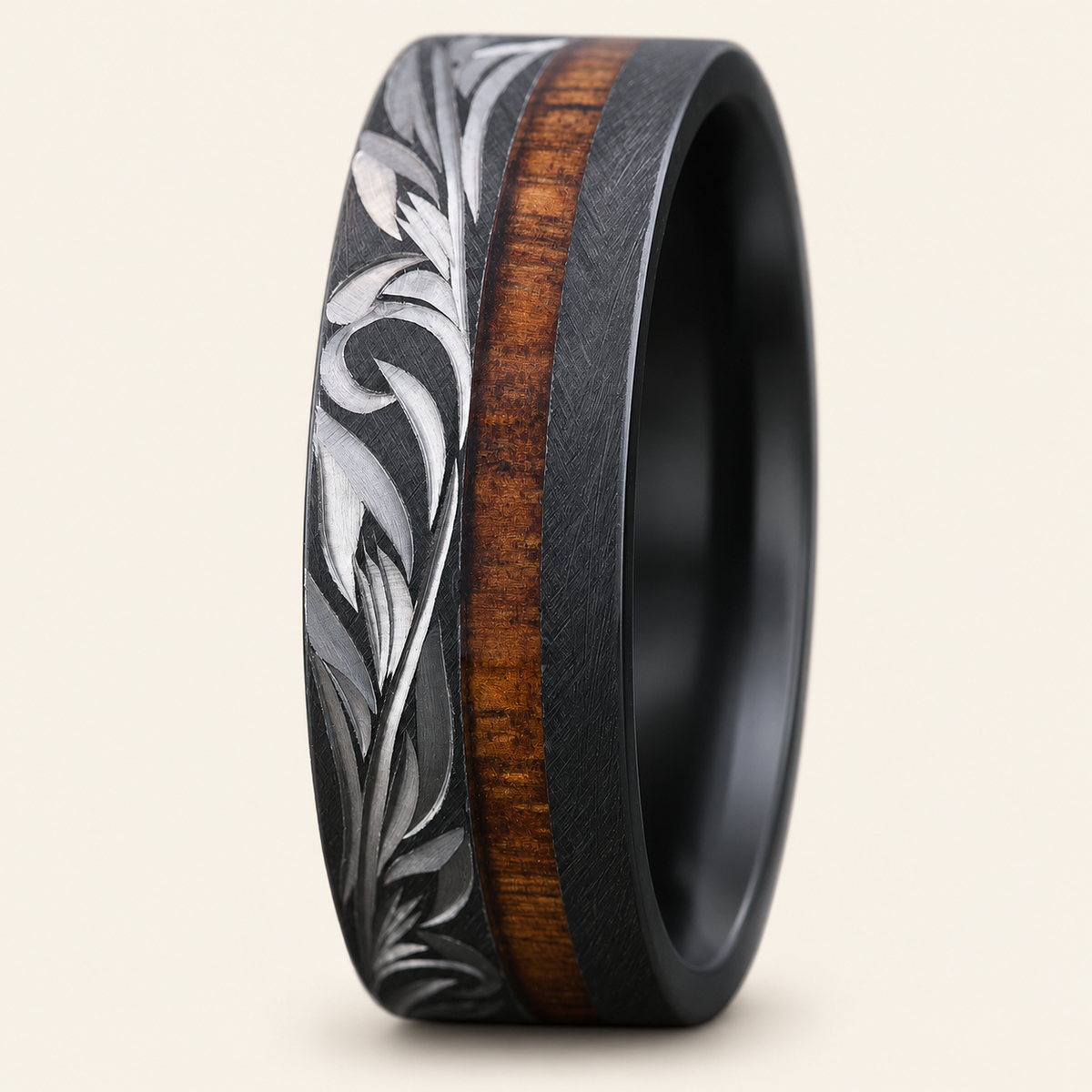
Solid 14K or 18K gold with koa inlay
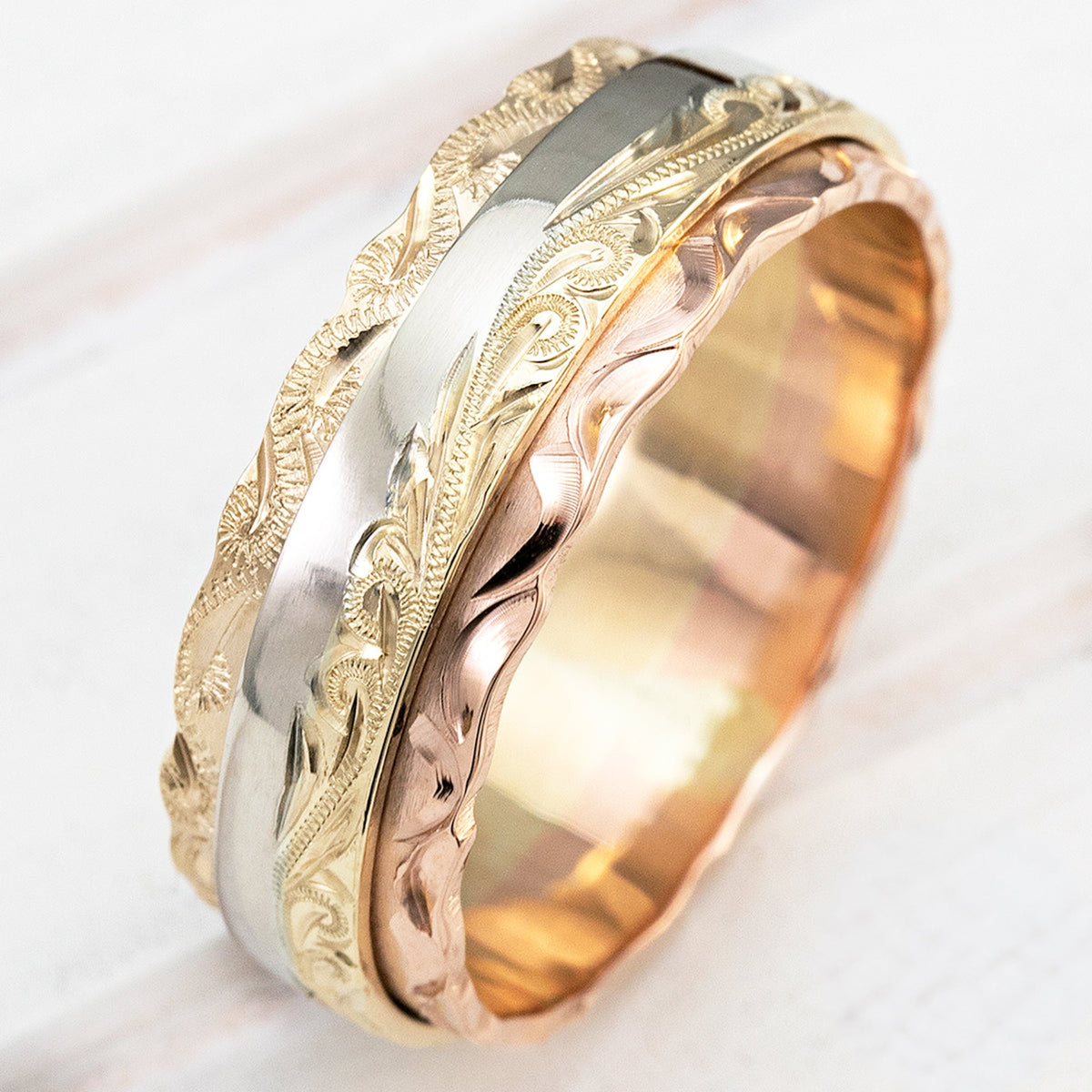
Here gold is the actual band. Happy Laulea's guide notes that a solid gold band "picks up a patina of fine scratches but can be polished and passed down." That patina is normal for a soft precious metal, and a jeweler can refinish it. It's the best fit for a solid gold inlay koa wood ring meant to last decades, whether men's or women's styles.

Gold-plated or ion-plated tungsten carbide with koa
You get the warm gold look at a fraction of the price, "with the understanding that the color lives on the surface." The tungsten core is very hard, so the band itself rarely scratches. The gold color layer, however, is finite.

Titanium with koa
Titanium is lightweight and hypoallergenic, and it's generally less likely than tungsten to be damaged by a hard knock. It shows more surface wear than tungsten, so expect fine scratches over time. Some buyers choose a titanium ring with a gold-colored inlay accent, which keeps the weight low.

A common mix-up: "gold plated" doesn't have the lifespan of solid gold. Ask what's under the color before you buy.

Durability: scratches and impact are different problems
Mohs hardness is the standard scratch-resistance scale, running from talc at 1 to diamond at 10. Tungsten carbide and ceramic score high, which is why they stay smooth. But Happy Laulea's guide makes an important distinction: "Scratch resistance is not the same as toughness. Tungsten and ceramic win on scratches and lose on impact."
In practice, a very hard ring resists a thousand tiny scrapes but can chip or crack under a sharp blow. A softer metal like gold or titanium scuffs more easily but tends to dent or bend rather than shatter.
Design helps too. Wider bands show more surface wear, and a domed or comfort-fit profile reduces snagging on gloves and pockets.
One safety note about tungsten: its hardness means it can't easily be cut off in an emergency. Happy Laulea has pointed out that tungsten carbide rings "cannot be easily cut or removed in emergency situations," so a comfortable fit matters, especially if your hands swell.

Koa wood inlay: sealed, not permanently waterproof
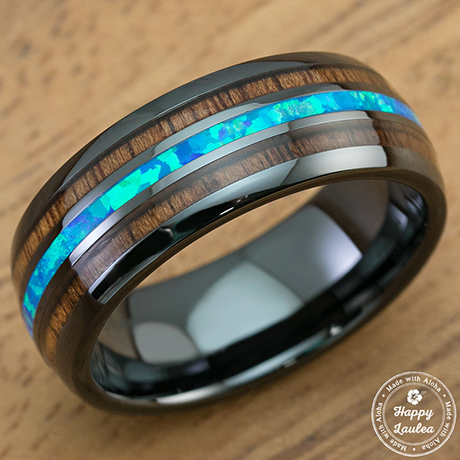
Koa is sealed inside its channel, and as the guide explains, "That sealant is what stands between the wood and the world." Sealant slows moisture; it doesn't stop it forever. Treat "waterproof" claims on any koa wood ring with caution.
Conservative guidance from Happy Laulea:
-
Handwashing or rain: fine. Dry the ring afterward with a soft cloth.
-
Showering: avoid it.
-
Ocean, pools, hot tubs: "Do not swim, surf, or soak in it."
For cleaning, use mild soap and a soft cloth, then dry fully. Skip harsh chemicals, solvents, ultrasonic cleaners, and steam.
Watch for lifting edges, small cracks, or a white film in the wood. These suggest the seal is compromised. Stop wearing the ring in water and contact the maker before the wood takes on more moisture.
As for color, koa varies naturally, so your ring's grain will differ from any photo, and the wood can deepen gradually with wear and light.

Gold plating and ion plating: what to expect
Happy Laulea is direct about this: "Standard gold plating on a daily-wear ring typically shows visible wear within months to about two years. Ion plating lasts noticeably longer." Plating is measured in microns, and a thin layer on a surface that touches everything simply won't last forever.
To stretch it:
-
Put the ring on after lotion, sunscreen, perfume, and cosmetics.
-
Remove it for the gym, cleaning, and swimming.
-
Wipe with a soft cloth.
-
Store it away from harder pieces that can rub the finish.
Be realistic, too. When plating wears through on a tungsten and koa ring, replacement is usually the practical path rather than re-plating. If you want gold that outlasts that cycle, solid gold is the better call. Engraving on a plated ring can also cut through the color layer, so consider leaving it plain if preserving the finish matters.

Resizing: koa rings change the rules
Happy Laulea's resizing article states that "a Hawaiian koa wood inlay ring cannot be safely resized through conventional jewelry methods." Heat can degrade the sealant and bond, and the wood can crack or splinter. In the brand's words, "Nothing here is resizable once a koa channel is set, apart from small adjustments on precious metal." Tungsten, titanium, ceramic, and zirconium versions are all in the non-resizable group.
So get the size right at the start:
-
Measure in the evening, when fingers are warmest and largest.
-
Use a sizer that matches the ring's width, since wider bands fit tighter.
-
Know whether the ring is comfort fit or standard fit.
If a size is off, ask about exchange or remake options before you order, and note that engraved pieces are often excluded.
How to choose your gold koa ring
-
Pick your base metal. Solid gold, a gold-tone tungsten or titanium look, or plain titanium.
-
Rate your daily risks. Scratches, impact, water, chemicals. Which dominates?
-
Choose a profile. A domed, comfort-fit band suits most daily wearers.
-
Confirm sizing and engraving. Decide on engraving only if you accept the finish tradeoff.

The best gold koa ring is the one that fits your risk profile
Choose a hard tungsten core with a gold look for scratch-heavy days, solid 14K or 18K gold for an heirloom, or titanium for light weight and sensitive skin. Whatever you choose, keep the koa out of water and get the size right the first time.
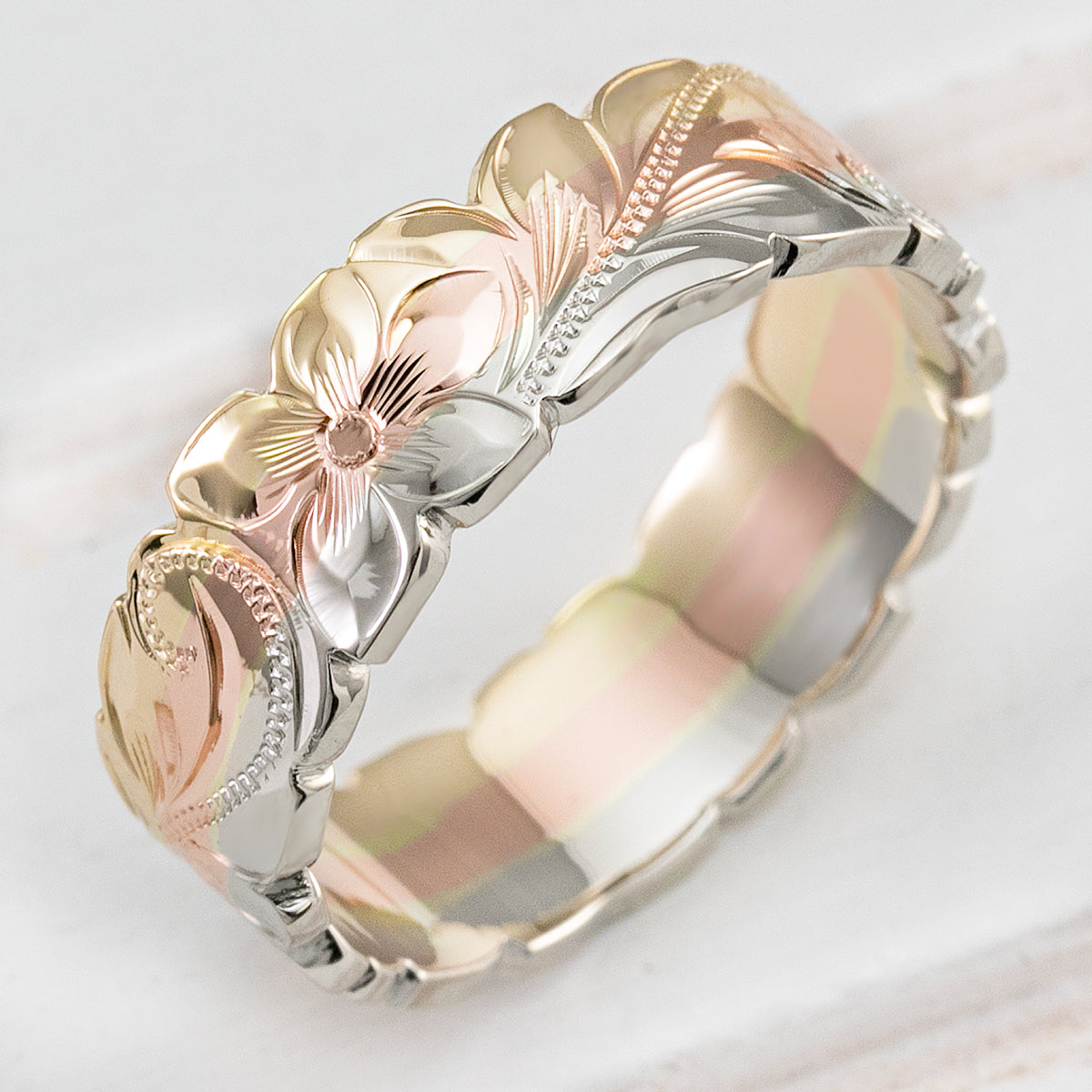
Shopping for a matching set? Browse our gold wedding rings for his and hers bands, or our gold pendants if you want that island gold look on a necklace too.

Happy Laulea has a working studio in Hawaii and over 4,800 five-star reviews, and the team is happy to help you sort through sizing and material questions. Tell us how you'll wear the ring, and we'll help you find the right match.