

12 unique wedding band alternatives for couples
Plain gold is a perfectly fine choice. But if you're the kind of couple who wants your wedding bands to say something more specific about who you are, there are genuinely better options. The good news: nontraditional wedding ring materials have come a long way, and Saga Bands' 2025 trends data confirms that materials like tungsten carbide and titanium are increasingly popular among couples making exactly this shift.
This list covers 10 unique wedding band alternatives, with honest tradeoffs for each so you can narrow down your shortlist fast. There's also a comparison table and a quick decision filter at the end if you'd rather skip straight to the verdict.
1. Titanium: the everyday workhorse
 A titanium wedding band is light, strong, and comfortable enough to forget you're wearing it. That last quality matters more than people expect after a few years of daily wear. Titanium sits just below tungsten on scratch resistance (Brilliant Earth notes tungsten leads the pack, followed by titanium and zirconium), but it won't shatter if you drop it, which tungsten can.
The tradeoff: if you want a deep black look, titanium typically gets there through anodizing or PVD coatings that can wear over time, not through the metal itself.
Best for: active couples, healthcare workers, anyone who wants feather-light comfort.
Happy Laulea angle: pair a titanium band with a hand-engraved Maile or wave motif to add symbolism that no coating can wear away.
2. Tungsten: maximum scratch resistance
 Tungsten carbide is the hardest common wedding band material available. According to Brilliant Earth, it's generally considered the most scratch-resistant metal for wedding rings. That reputation is well-earned. The catch: that same hardness makes it brittle under sharp impact, and resizing is rarely possible. Buy for your current size.
Best for: couples who want a ring that looks brand-new five years from now, and don't expect their ring size to change.
Happy Laulea angle: tungsten's durability pairs beautifully with an inlay accent (Koa wood, opal, meteorite) so the band combines toughness with genuine character.
3. Ceramic / black ceramic: bold color that won't fade
 If you want a consistently dark band, black ceramic wedding rings hold their color far better than coated metals. The color goes all the way through, so surface scratches don't reveal a lighter metal underneath.
The weakness is the same as tungsten: ceramic is brittle. A hard knock on a countertop edge can chip or crack the band, and resizing isn't possible.
Best for: couples who love the sleek, matte-black aesthetic and don't work with their hands heavily.
Happy Laulea angle: if going bold black, add a Hawaiian engraving so the meaning stays intact regardless of surface wear.
4. Black zirconium: a dark look that isn't just a coating
 Unlike black titanium (which is typically a surface treatment), black zirconium gets its color through an oxidation process that converts the outer layer of the metal. It's a more integrated darkness, which appeals to couples who've done the research and want a black ring that holds up honestly over time.
Care needs are similar to other alternative metals: avoid prolonged moisture and harsh chemicals.
Best for: couples who want a genuine black band with a durable, non-coating color story.
5. Meteorite rings: literally one-of-a-kind
![Titanium GR5 Ring [4mm width] Meteorite](https://cdn.shopify.com/s/files/1/1385/5623/files/titanium-category-8198982762796-clean-2000x2000.jpg?v=1789865631) Every meteorite ring inlay is unique. The Widmanstätten pattern (the crystalline iron-nickel lattice visible in Gibeon meteorite) formed over billions of years and can't be replicated. According to Thorum's meteorite guide (December 2025), meteorite is typically set as an inlay within a protective ring body made of tungsten, titanium, or gold precisely because the iron-nickel material needs that structural support.
Every meteorite ring inlay is unique. The Widmanstätten pattern (the crystalline iron-nickel lattice visible in Gibeon meteorite) formed over billions of years and can't be replicated. According to Thorum's meteorite guide (December 2025), meteorite is typically set as an inlay within a protective ring body made of tungsten, titanium, or gold precisely because the iron-nickel material needs that structural support.
The honest tradeoff: meteorite can rust if moisture sits on it. Thorum's guidance recommends keeping the ring dry and following a regular sealing and maintenance routine.
Best for: couples who want a ring with a genuinely unrepeatable story, and who don't mind a simple care habit.
Happy Laulea angle: Happy Laulea incorporates meteorite as an inlay accent alongside Koa wood or black jade, so it reads as heirloom jewelry rather than a novelty piece.
6. Mokume-gane: the organic metalworking tradition
Mokume-gane is a centuries-old Japanese technique that layers and fuses different metals together, then works the billet until the layers create flowing, wood-grain-like patterns. No two rings look the same. Multiple craftspeople and historians describe the process as involving diffusion bonding or forge welding to create the layered billet before it's shaped.
The tradeoff is real: finding a skilled maker matters, and mokume-gane commands a higher price for that reason.
Best for: couples who want something that looks organic and handcrafted, not machine-stamped.
7. Koa wood wedding bands: Hawaiian identity you can wear
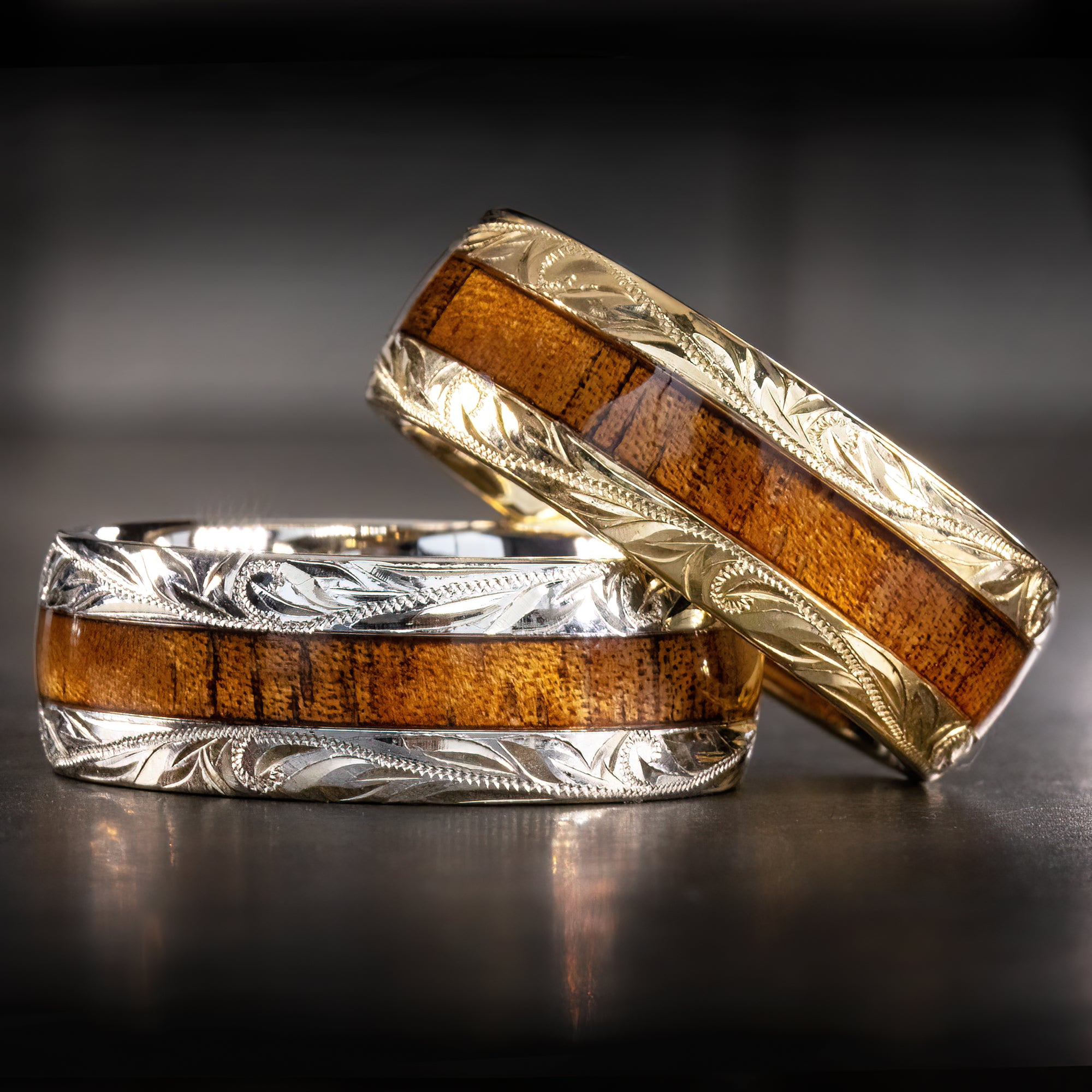
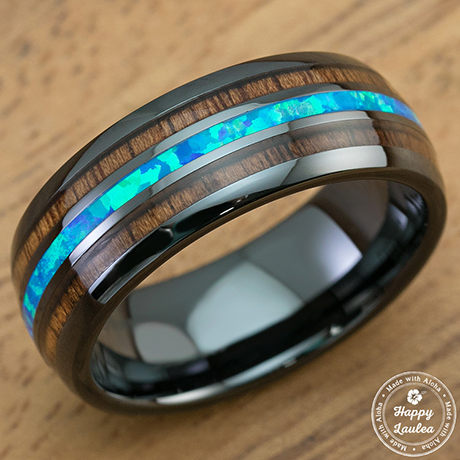
 Hawaiian Koa wood is one of the most distinctive natural materials available in fine jewelry. It's warm, richly grained, and carries genuine cultural weight in Hawaiian tradition. A wood inlay wedding band keeps that warmth close to the skin while a metal outer structure protects the wood.
Care is simple but real: remove the ring during prolonged water exposure (pools, saltwater), avoid harsh chemicals, and don't use ultrasonic cleaners on inlay pieces.
Best for: couples with a connection to Hawaii or the Pacific, or anyone who wants warmth and nature built into the band.
Happy Laulea angle: this is where Happy Laulea is built to shine. Koa wood rings handcrafted in Hawaii, paired with Maile or wave engravings, carry a depth of meaning that no mass-market band can replicate.
8. Opal inlay: color that moves
 Opal doesn't behave like a static stone. Depending on the light, it shifts through green, blue, and amber, which makes an opal inlay ring feel alive in a way that's hard to photograph and easy to fall in love with. A well-set inlay protects the opal from the edges in, so daily wear is reasonable.
Avoid harsh impact and chemical exposure (think cleaning products and chlorine), and you'll keep that color shift for years.
Best for: couples who want something romantic and visually unpredictable, without going full gemstone solitaire.
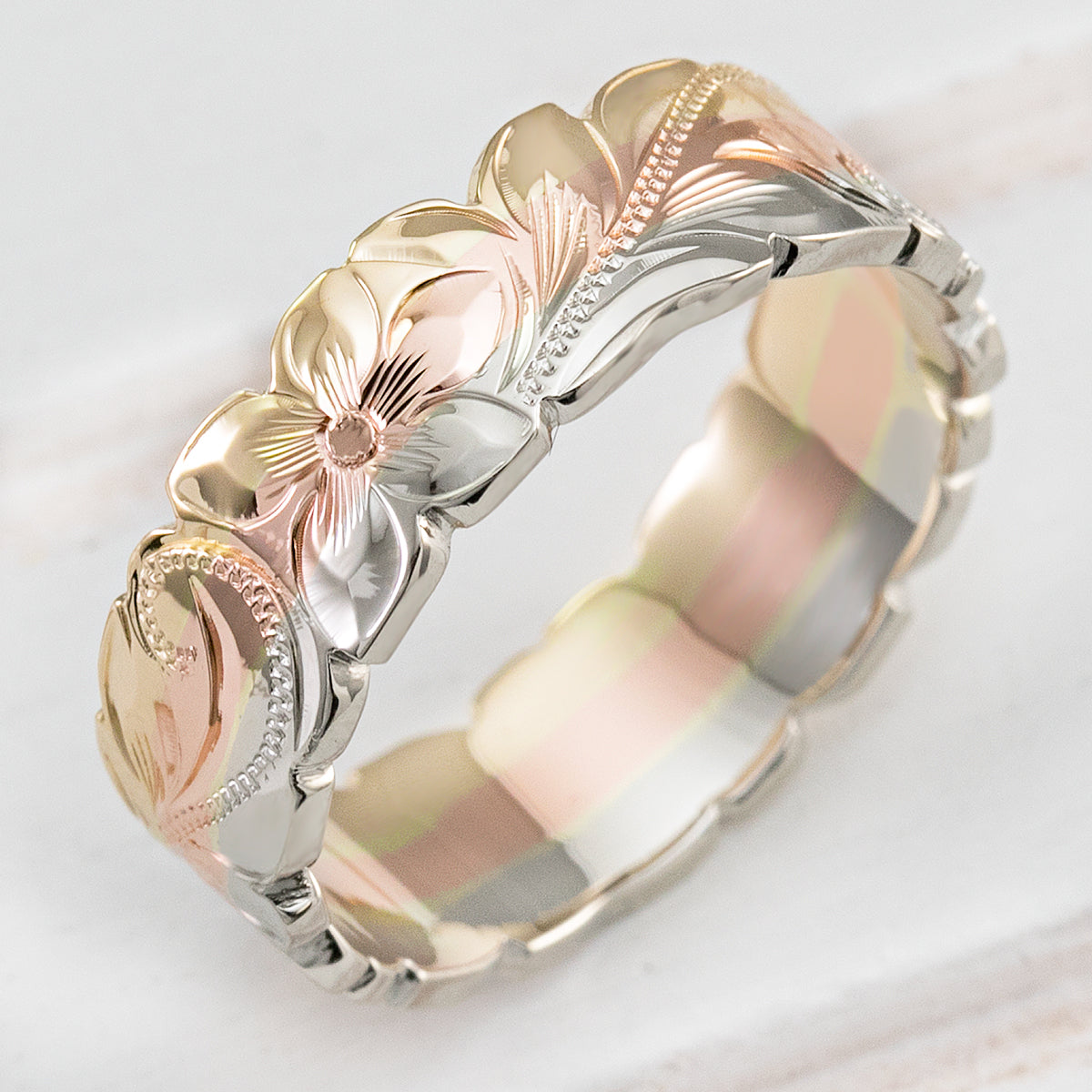
Happy Laulea angle: opal paired with a hand-engraved Hawaiian Plumeria motif is one of the most visually striking couple-set combinations available.
9. Black jade and abalone shell: ocean and island color
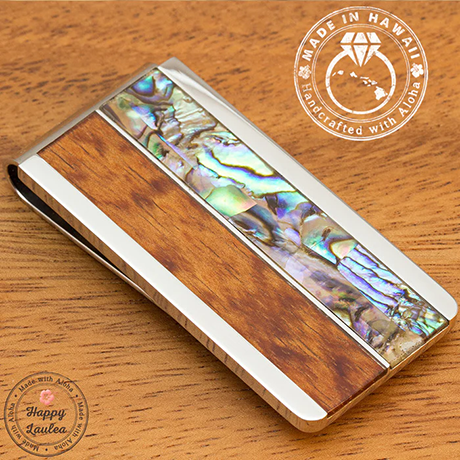
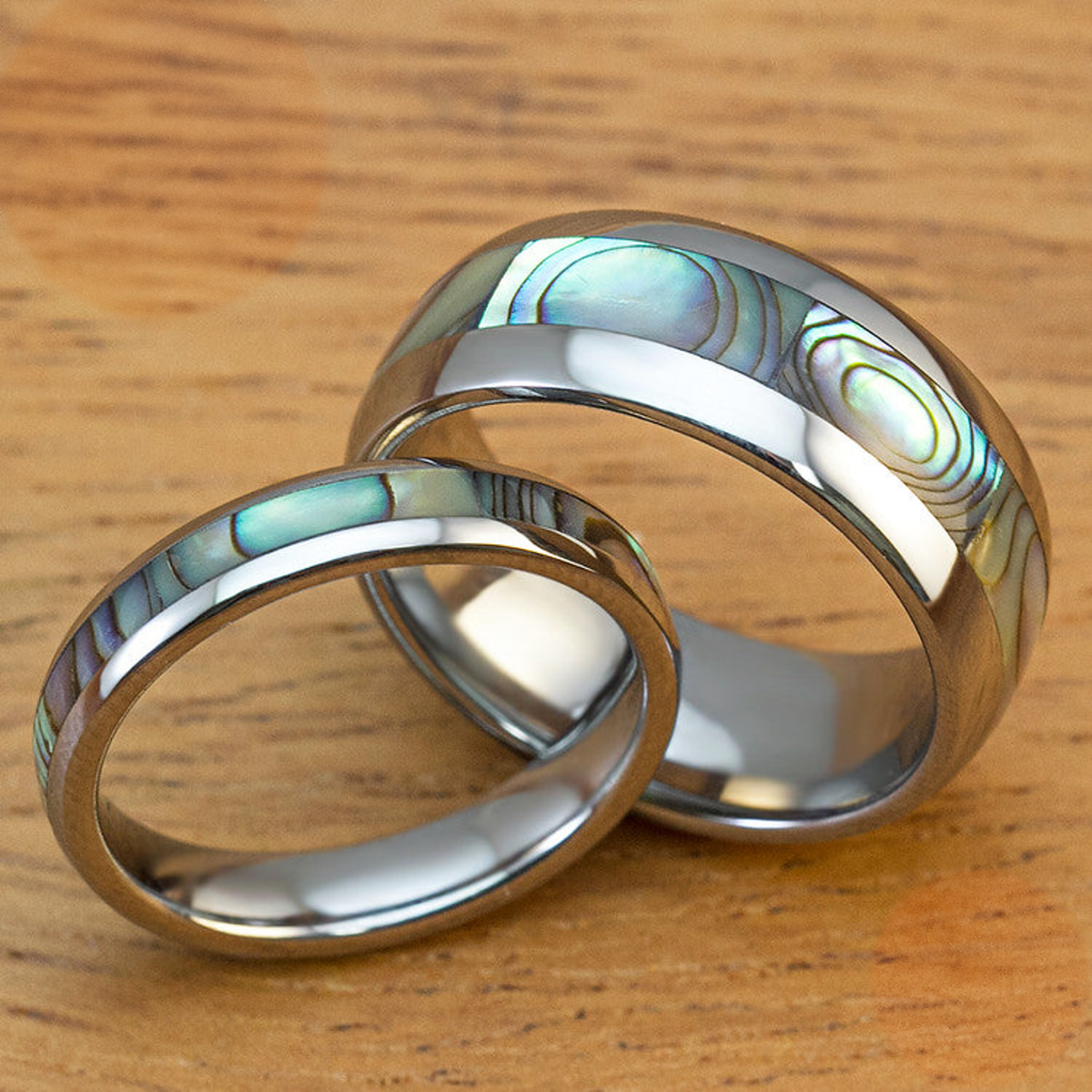
Black jade has a deep, quiet richness that doesn't shout. Abalone shell brings iridescent coastal color (think the inside of a conch, playing green-blue-gold in the light). Both materials carry a Pacific identity that's hard to fake with manufactured alternatives.
Wear and longevity depend on how deep the inlay sits and how well the setting protects the edges. Proper sealing and care keep these materials looking their best.
Best for: couples drawn to coastal aesthetics, island heritage, or ocean symbolism.
Happy Laulea angle: these accents work especially well in couple-set ring designs, where one partner's band features abalone and the other features black jade, tied together by a shared engraving or metal base.
10. Mixed-metal and two-tone bands
 A two-tone band doesn't have to look dated. When the metals are chosen with intention (say, yellow gold and black zirconium, or silver and rose gold), the contrast adds dimension without feeling busy. The tradeoff worth knowing: different metals wear at different rates, so after years of daily wear the surface can develop slight unevenness where two metals meet.
Best for: couples who want visual interest without committing fully to an alternative material.
Happy Laulea angle: a couple's set approach works well here. Each partner wears a band that flips the material ratio, so one ring is mostly gold with a Koa inlay, and the other is mostly Koa with gold detail. Symmetry through contrast.
11. Hammered, textured, and wave-edge profiles
Sometimes the material isn't the variable: the shape is. A hammered wedding band, a brushed-finish band, or a wave-edge profile adds visual interest to a ring that might otherwise read as plain. Textured surfaces do pick up micro-scratches over time, but on a matte or hammered finish, those scratches tend to blend rather than stand out.
Best for: couples who want uniqueness but aren't ready to commit to alternative materials, or who want to keep a traditional metal with a more interesting silhouette.
Happy Laulea angle: wave-edge detailing connects directly to Hawaiian ocean motifs. Pair a hammered titanium band with a hand-engraved interior for a ring that's simple on the outside and personal where it counts.
12. Work-friendly rings (silicone and removable bands)
Some jobs genuinely aren't safe for metal rings: electrical work, surgery, manual trades. A silicone wedding band alternative lets you wear your commitment to work without the ring becoming a hazard. The emotional tradeoff is real: a silicone band doesn't feel the same as your actual wedding ring.
One approach: wear your primary ring for everything outside of work, and keep a silicone backup for the job site. The primary ring still does its symbolic job the rest of the time.
Best for: couples in manual trades, healthcare, or any industry with ring-related safety protocols.
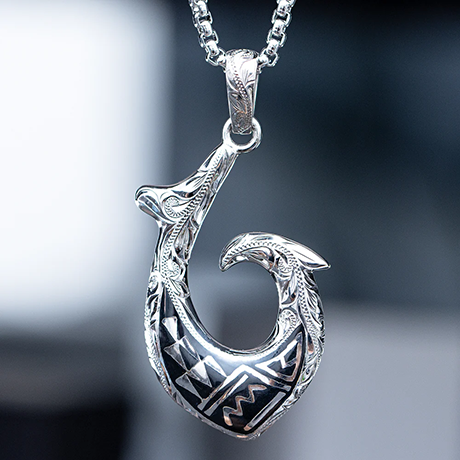
Happy Laulea angle: if you're removing your ring regularly for work, consider a matching pendant as a secondary meaning-holder. Happy Laulea's fish hook Makau pendants and Hawaiian-inspired necklaces work well for exactly this purpose.
How these materials compare: scratch resistance, durability, and resizing
|
Material |
Scratch resistance |
Brittle/impact risk |
Resizable? |
Maintenance level |
|---|---|---|---|---|
|
Titanium |
High |
Low |
Limited |
Low |
|
Tungsten carbide |
Very high |
High (can shatter) |
No |
Very low |
|
Black ceramic |
High (color stays) |
High (can chip) |
No |
Low |
|
High |
Low-medium |
Limited |
Low |
|
|
Meteorite inlay |
Medium (depends on base) |
Low (base protects) |
Depends on base |
Medium (keep dry, seal) |
|
Mokume-gane |
Medium |
Low |
Yes (gold-based) |
Medium |
|
Koa wood inlay |
Medium (metal outer) |
Low (metal protects) |
Limited |
Medium (avoid water/chemicals) |
|
Opal inlay |
Medium |
Low-medium |
Limited |
Medium (avoid impact/chemicals) |
|
Black jade / abalone |
Medium |
Low-medium |
Limited |
Medium |
|
Mixed-metal / two-tone |
Varies |
Low |
Often yes |
Low-medium |
|
Hammered / textured |
Varies by base metal |
Low |
Often yes |
Low |
|
Silicone |
Low |
Very low |
Yes (buy new size) |
Very low |
Quick callouts:
-
If you want zero daily maintenance and scratch resistance above everything else, tungsten carbide is the clearest answer.
-
If you want uniqueness you can tell a story about, meteorite inlay or Koa wood beats tungsten on personality every time.
-
If you both work with your hands but still want meaning in the design, titanium with an engraved motif offers the best balance of durability, weight, and customization.
How to choose your material in about 60 seconds
Work through these three filters and you'll have a short-list of two or three options.
Lifestyle filter:
-
Office or light daily wear: almost anything works. Focus on aesthetics.
-
Active or outdoor lifestyle: titanium, tungsten, or black zirconium.
-
Manual trades or safety-conscious work: silicone backup plus a meaningful primary ring.
Aesthetic filter:
-
Bold black look: black ceramic or black zirconium (not a coating).
-
Natural, warm, organic: Koa wood inlay or mokume-gane.
-
Cosmic, totally unique: meteorite inlay.
-
Coastal or island-inspired: abalone shell, black jade, or Koa wood with ocean engraving.
-
Visual texture without alternative materials: hammered or wave-edge profile.
Care tolerance filter:
-
Happy to do light maintenance (sealing, keeping dry): meteorite inlay, Koa wood, opal, abalone.
-
Prefer genuinely low-maintenance: titanium, tungsten, black ceramic, black zirconium.
-
Want to remove and replace often: silicone band, or a lighter-weight titanium with secure comfort fit.
Your band can be meaningful and nontraditional
Plain gold isn't going anywhere, but it's no longer the default for couples who want their rings to reflect something real. The best alternative wedding band isn't necessarily the most scratch-resistant or the most exotic; it's the one that matches your daily life and holds a meaning worth keeping.
If you want to explore Hawaiian-inspired materials crafted in Hawaii by hand, Happy Laulea's workshop offers Koa wood, meteorite, opal, abalone, black jade, titanium, and engraved couple sets that you can personalize together. Studio visits are available by appointment, which is a genuinely different experience than ordering from a photo online.
Start with your lifestyle filter, pick two materials that match your aesthetic, and go from there.