

Hawaiian Heirloom Jewelry: History, Meaning & How to Choose

Hawaiian heirloom jewelry is one of the most distinctive and personal jewelry traditions in the world. It's also one of the most misunderstood. The term gets used loosely, so it's worth knowing exactly what it means, what it looks like, and why pieces made in this tradition carry so much weight as gifts and family keepsakes.
What "heirloom" actually means in Hawaiian jewelry
In the context of jewelry, "heirloom" isn't just a stylistic label. It describes a specific behavioral intent: a piece that was made to be personalized, given at a meaningful milestone, and kept within a family across generations.
Hawaiian heirloom jewelry sits squarely in that category. These pieces are designed to carry a person's name, a loved one's name, or a term of endearment. They're made with the kind of construction quality you'd expect from something meant to outlast the person who first wore it. And they're given at moments that matter: weddings, graduations, anniversaries, birthdays, and homecomings.
That's what separates them from fashion jewelry. Fashion jewelry follows trends, often uses generic or interchangeable designs, and isn't built with longevity or deep personalization in mind. An heirloom piece, by contrast, is specific to someone. It has their name on it. It was chosen with intention and crafted to last.

Where the tradition came from
The origin story most people know goes like this: in 1887, Queen Kapiʻolani and Princess Liliʻuokalani traveled to England for Queen Victoria's Golden Jubilee. According to accounts repeated by jewelers including Na Hoku, Queen Victoria presented Princess Liliʻuokalani with a solid gold bracelet engraved in Old English lettering and enameled in black. Liliʻuokalani brought that style home to the islands, and Hawaiian craftspeople adapted it into what became a distinct local tradition.
It's a compelling story, and it does connect the jewelry's recognizable Victorian design language to a real historical moment. That said, some jewelry historians challenge the details. Philip Rickard Honolulu has argued the bracelet-as-royal-gift story is likely inaccurate, and that the tradition actually traces to an earlier piece called the "Hoomanao Mau" bracelet, which dates to the 1860s. The Images of Old Hawaiʻi blog (April 2014) also notes that black enamel was already associated with English mourning jewelry after Prince Albert's death in 1861, and that Hawaiian royalty were in contact with English jewelry traditions well before the 1887 Jubilee. The same source records that in 1893, Queen Liliʻuokalani presented Zoe Atkinson a gold enameled bracelet engraved with "Aloha Oe" and her name.
What all of these accounts agree on is that the defining features of Hawaiian heirloom jewelry, Old English-style lettering, black enamel, and Hawaiian motifs engraved in gold, were established during the Victorian era.
The design details that make it recognizable
Hawaiian heirloom jewelry is instantly recognizable once you know what to look for. As we describe in the Happy Laulea heirloom jewelry history, the pieces are defined by "delicately scrolled and intricately engraved details" that trace directly to Victorian craftsmanship conventions.
The core design elements are:
-
Old English-style lettering: The flowing, ornate script that was standard in Victorian England became the hallmark of Hawaiian heirloom pieces. Na Hoku describes it as "lettering engraved in Old English style as was traditional in the days of Queen Victoria."
-
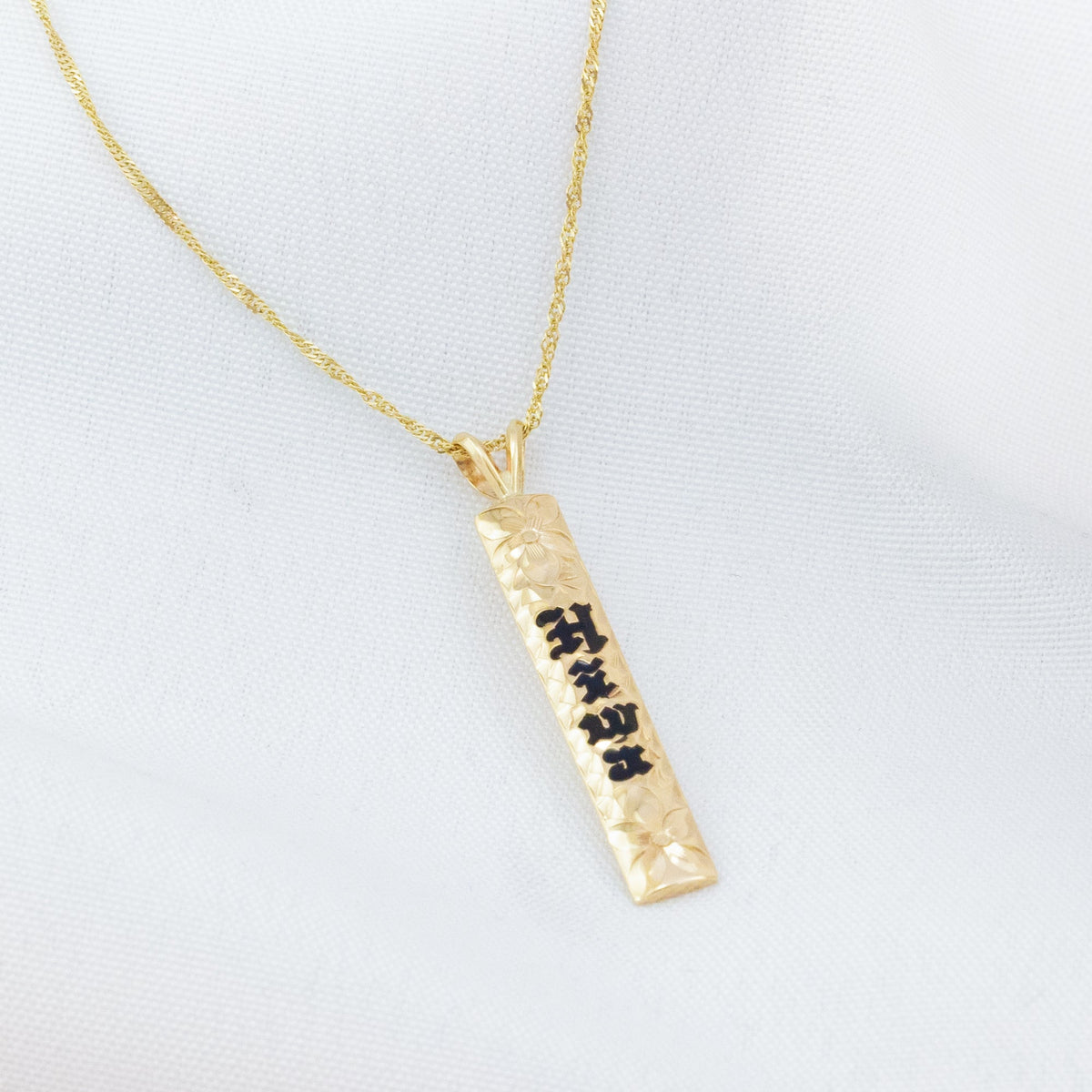
Black enamel fill: Lettering and decorative elements are often filled with black enamel, which creates strong contrast against a gold background. This is one of the most visually distinctive features of the style.
-
Two engraving types: Engraved lettering is carved directly into the metal, sitting below the surface. Raised lettering (sometimes called "raised style") has the letters standing above the band, with the surrounding background recessed. Both are authentically Hawaiian heirloom in character.
-
Scrollwork and decorative borders: Flowing scroll patterns, scalloped edges, and wave-cut edges frame the lettering and carry Hawaiian design language across the surface of the piece.
-
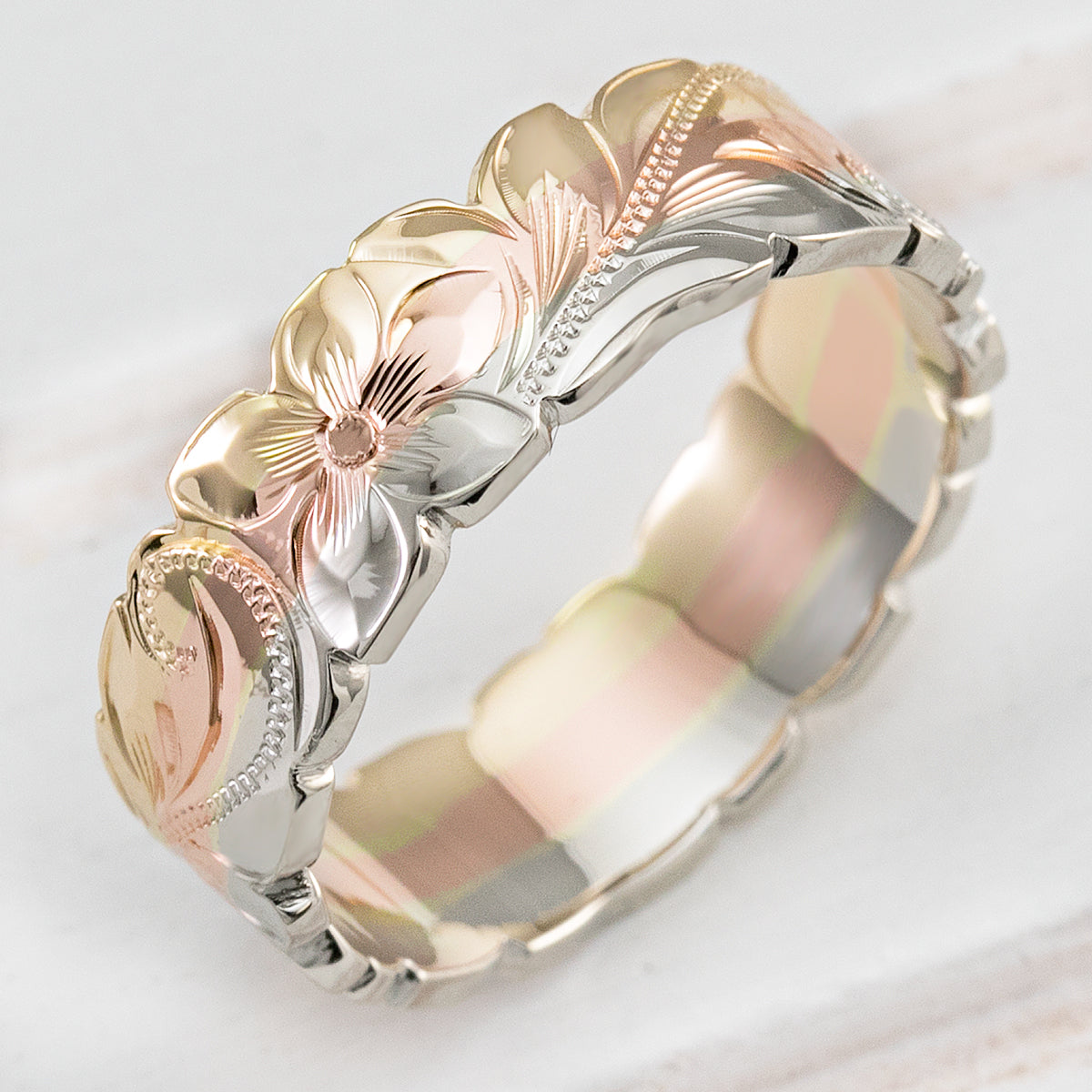
Hawaiian floral motifs: Hibiscus and plumeria are the most common flowers worked into heirloom designs. Maile leaves also appear frequently, particularly in ring and bracelet scrollwork. These motifs aren't decorative fillers; they connect the piece to specific places and cultural meaning in the islands.
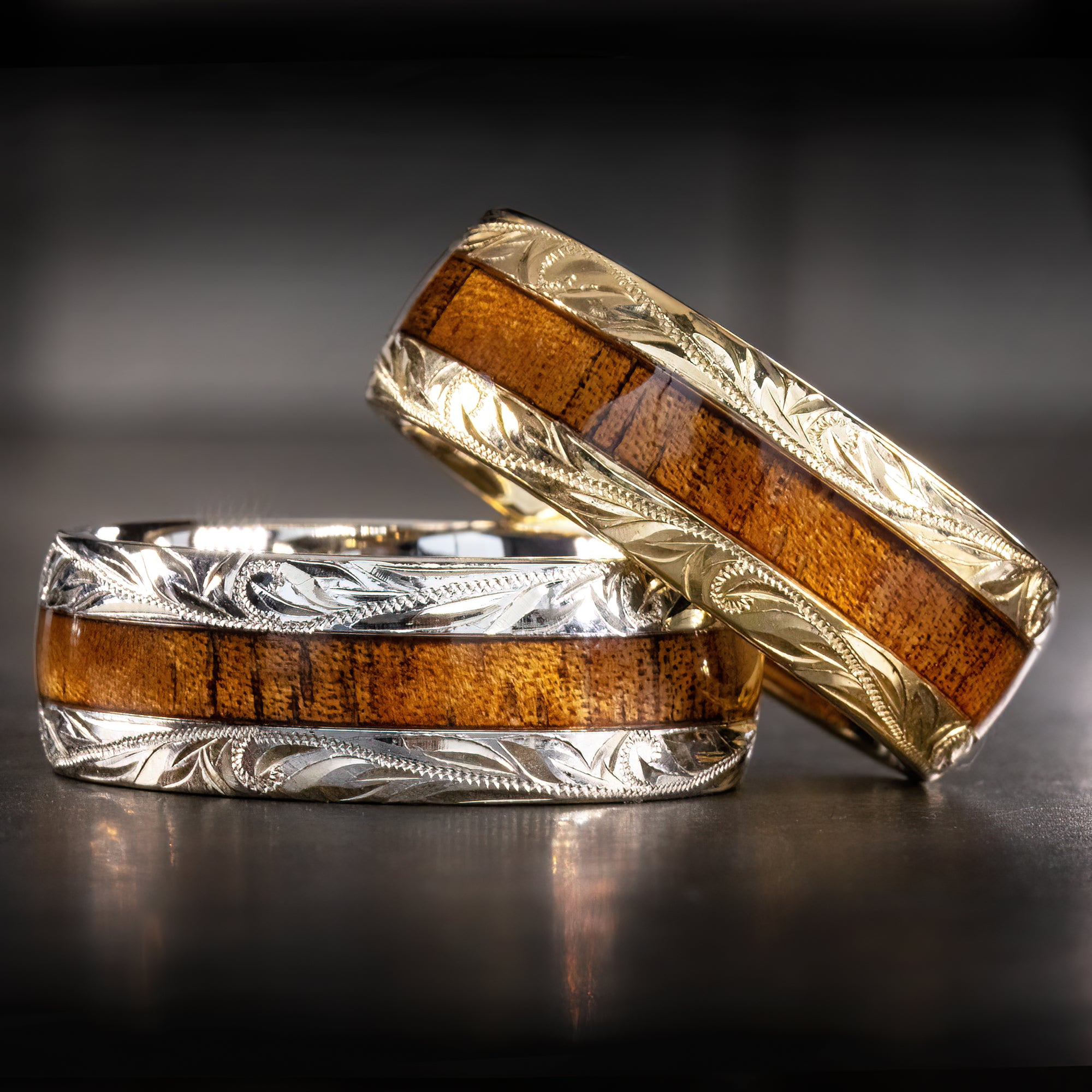
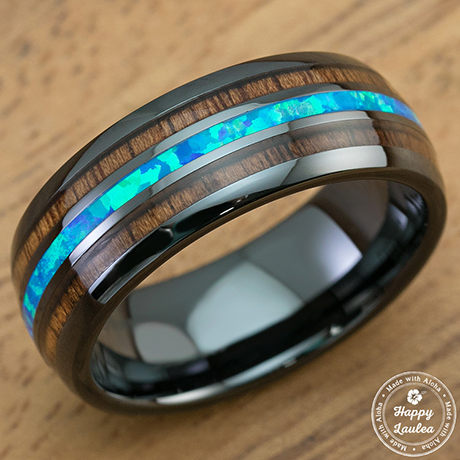
Historically, these pieces were made in yellow gold. As we note in our blog, most original Victorian-style Hawaiian heirloom pieces were yellow gold. Today, craftspeople work in sterling silver, white gold, and contemporary metals like titanium and Koa wood-inlaid designs, but the engraving style and motif vocabulary remain consistent.

The three traditional forms
Bracelets and bangles
The bracelet is the original Hawaiian heirloom form. A traditional heirloom bracelet carries a name or phrase in Old English script, surrounded by scrollwork and often set with a hibiscus or plumeria motif. The lettering is enameled in black or left as raised metal, and the edges are typically scalloped or wave-cut. These are the pieces most people picture when they hear "Hawaiian heirloom jewelry." A personalized name bangle with cutout wave edges is a great example of how the traditional format translates into a wearable modern piece.
Rings
The heirloom ring translates the bracelet's scroll vocabulary to a band format. Scrollwork wraps continuously around the ring, and a name or phrase in Old English script sits at the top of the band. Flowers appear when requested but aren't always included in the standard scroll design. The effect is a band that looks unmistakably Hawaiian, not generic. Browsing the Hawaiian heirloom engraved ring collection gives a good sense of how this tradition adapts to different widths and metals.
Pendants
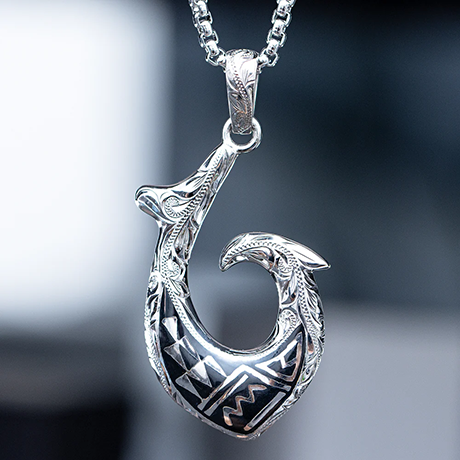
The heirloom pendant typically carries a name, a Hawaiian word, or a meaningful phrase set in Old English script, with Hawaiian floral motifs framing the text. Plumeria pendants are especially popular. The Makau (fish hook) pendant is a related Hawaiian jewelry form with its own cultural symbolism around strength and provision. At Happy Laulea, the solid gold heirloom pendant collection spans traditional name styles and motif-forward designs. If you're drawn to floral pendants specifically, the plumeria jewelry collection shows how widely that motif appears across forms.
How to choose a piece that's genuinely heirloom quality
Not every piece with a Hawaiian motif qualifies. If you're shopping for something you actually want to pass down, here's what to look for:
Engraving quality. Look closely at the lettering. Hand-engraved pieces have subtle variation and depth that machine-produced work doesn't replicate. The scrollwork should flow naturally, not look stamped.
Enamel contrast. If the piece features black enamel, check that the fill is clean and even. Good enamel contrast makes Old English lettering legible and visually crisp. Poor fill looks cloudy or patchy.
Metal type and construction. Heirloom jewelry should be repairable and long-lasting. Solid gold (typically 14K) is the traditional choice. Sterling silver is a widely used and durable modern option. Contemporary metals like titanium and tungsten carbide are harder to resize or repair, so weigh that against longevity if passing the piece down is a priority.
Personalization that fits the piece. Choose your wording thoughtfully. Most heirloom bracelets and rings have space for a name or short phrase. A name in Hawaiian, a term of endearment, or a significant date all work beautifully. Make sure the text length fits the surface area so the design isn't cramped.
Maker provenance. Buy from a maker who can tell you clearly: what metal the piece is made from, whether the engraving is done by hand, and what distinguishes their work from fashion-style Hawaiian pieces. At Happy Laulea, every heirloom piece is handcrafted in Hawaii, which means the design decisions are made by people with direct connection to the tradition.
Hawaiian heirloom jewelry endures because it's built around something that fashion can't replicate: a specific person's name, a specific relationship, and the craftsmanship to make both last. That's what you're looking for, and now you know how to find it.